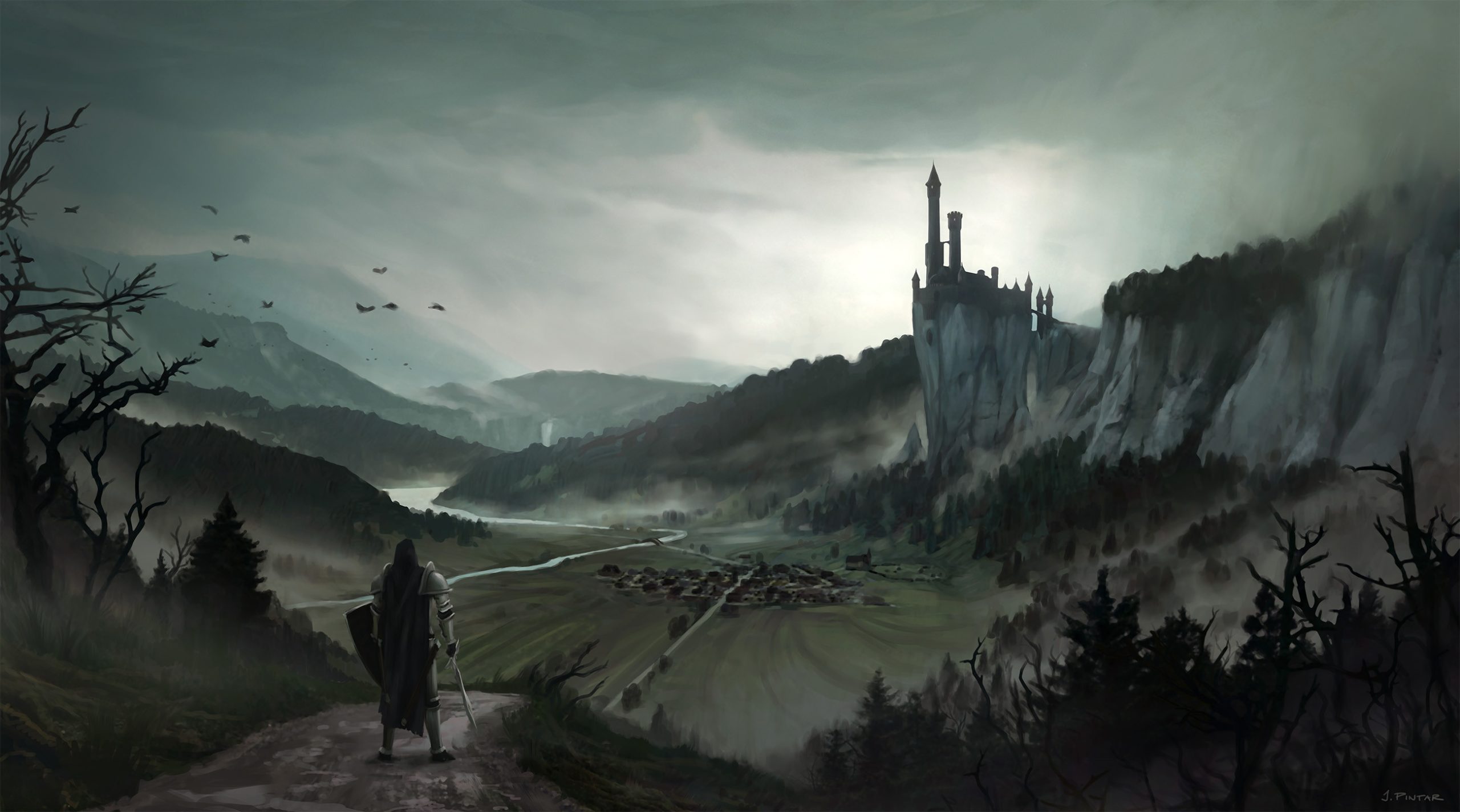
Chapter I — The Debt
The raven found them in Darkon shortly before noon.
It was a miserable-looking thing, black feathers gone gray around the edges from rain, and it circled twice before settling near Validus. The bird belonged to him, though in the manner of ravens it had never seemed particularly interested in the distinction between belonging to and occasionally consenting to return. Today it had returned with something tied beneath its wing.
There was a letter.
Validus recognized the stationery before he had finished removing it. Very few men in the Domains of Dread possessed either the vanity or the disposable income to commission correspondence bearing their own name in lettering better suited to a theater marquee.
ALANIK RAY, INVESTIGATOR OF THE OCCULT.
Beneath it, an engraved eye stared solemnly from the paper.
Alanik had not forgotten Richemulot.
That was more or less what the letter said, although Ray used considerably more words to say it. The Van Richten Society had saved him there, and Alanik considered the debt outstanding. He and Arthur had recently been occupied in Mordent by the reappearance of the Priests of Osybus, another little eruption of an old disease that never seemed quite willing to die.
The priests themselves were no longer the problem. Alanik and Arthur had seen to that.
What they had left behind was more interesting.
Among their records was a ledger documenting recent contact with a woman named Elisabeta Durst. Several occult scrolls had changed hands. The payment had been substantial, and the transaction had not been made directly. A Vistani parley had carried the goods through the Mists to a place somewhere near the Svalich Woods.
It was not the sort of purchase one made accidentally.
Nor, Alanik suggested, was it likely to represent the entirety of the exchange.
He wanted someone to follow the trail.
Darkon was nearer to the Svalich Woods than Mordent, and the Van Richten Society was already there. More importantly, rumor had reached him that the Society presently traveled with a Vistana. With people disappearing in the Mists around the place of exchange, that was no small advantage. Alanik’s final warning was characteristically elegant and just vague enough to be irritating: if Our Guardian in the Mists continued to favor their guide, perhaps the risk could be reduced.
It was, by the standards of the Society, a perfectly reasonable assignment.
A death cult had bought forbidden magic for a wealthy woman through intermediaries. Alanik owed them a favor. There were disappearances to investigate and a name worth following.
So they went.
The road from Darkon toward the Svalich Woods offered no immediate indication that it intended to become anything more significant than a road. The land gave way gradually to trees, and the traces of settled country thinned behind them until there was little left but forest and the path running through it. Haleira traveled with Validus and PaK beneath an overcast sky while the wet woods closed around them.
The first mist might easily have been mistaken for ordinary weather.
It appeared low among the trees, pale against dark trunks, gathering where the road narrowed between them. There was nothing remarkable in seeing fog in Ravenloft. The Mists touched every domain eventually, and for Haleira they were more familiar than they could ever be to the two men traveling beside her.
That familiarity was precisely why she knew something was wrong.
The Mists did not simply gather around them. They pressed inward.
Haleira called upon her spirits.
They answered her as they always had, spectral guardians taking shape around the travelers and moving outward against the white. Their presence made a boundary of sorts, a moving wall of the dead against the encroaching fog. For a moment it worked. The Mists withdrew before them, opening space among the trees and leaving the party untouched at the center.
Then the Mists pushed back.
The first spirit disappeared into them.
There was no explosion of magic or contest visible to the eye. One moment the guardian was there and the next its outline had been swallowed by gray. Another followed. The remaining spirits pressed farther into the fog, but the distance between them and Haleira shortened rather than grew.
The Mists were winning.
Haleira forced more of herself into the invocation. Her guardians held for a few moments longer, their shapes burning pale against the forest, but the fog closed around them one by one. The thing that should have yielded to her refused to do so.
That alone would have been disturbing.
What she felt when she reached beyond it was worse.
Haleira knew what lived behind the Mists, or at least knew the sensations by which such things announced themselves. Ezra was not a woman waiting somewhere inside the fog to answer when called, but there was a presence to faith, a direction to it. The Dark Powers were something else entirely, distant and malign, less a voice than the knowledge that something enormous occupied the darkness whether one chose to acknowledge it or not.
She searched for either.
There was nothing.
Not silence.
Nothing.
No touch of Ezra. No trace of the Powers. No familiar spiritual pressure behind the veil. Whatever surrounded them did not feel like a road belonging to anything Haleira understood. The Mists seemed separated from every force by which she had ever known them.
They seemed to belong only to themselves.
The last of her spirits vanished.
Then the Mists came for the living.
They rolled over the road and through the spaces between the trees until the forest disappeared behind them. Validus faded into gray. PaK became an outline and then ceased to be one. Within moments there was no direction left from which the fog was coming because it occupied every direction at once.
No wind.
No sensation of movement.
Only coldness.
That made it worse.
The world did not rush away from them. The Mists simply removed it.
For several long moments there was nothing beyond the pale space immediately surrounding each traveler. No trees. No road. No horizon by which one might judge distance. A person could have been standing an arm’s length away or a hundred yards distant and appeared equally absent.
Then the gray collapsed.
It did not disperse like fog under sunlight. It seemed merely to withdraw all at once, and the world returned around them.
They were standing in the woods.
For an instant that was reassuring.
Then Haleira looked at the trees.
The forest had changed.
The trees through which they had traveled from Darkon had been ordinary woodland, wet and old and densely grown in places but recognizable as something shaped by seasons, animals, wind and human roads.
These trees were enormous.
Their trunks rose so close together that the spaces between them seemed unnaturally narrow, as though the forest had continued growing long after there ceased to be room for it. Their tops could not be seen. Great branches vanished into heavy gray mist suspended high above the earth, sealing away the sky and admitting only a dim, death-colored light.
The road remained beneath their feet.
Almost.
The shape of it was familiar enough to insist that this was still the path they had been walking, yet everything surrounding it contradicted that conclusion. The forest was too old. The trees stood where no trees had been moments before. The canopy had changed. Even the light seemed to belong to another hour.
Nothing moved among the branches.
There were no birds.
No insects called from the undergrowth. No small animal disturbed the leaves. The woods possessed the silence of a forgotten grave, complete enough that the ordinary noises of three travelers standing upon a road seemed intrusive.
And beneath that silence was something worse.
Not a sound, exactly.
A feeling.
The entire forest seemed caught at the instant before a scream.
It had no voice with which to make one.
Haleira knew only one thing with certainty.
These were not the woods they had been walking through moments before.
Yet they were.
The road had not ended. There had been no sensation of crossing a threshold, no journey through the Mists that she could recognize, no arrival marked by the familiar pressure of another domain taking hold around them.
One forest had simply become another.
The Mists lingered high among the treetops, indifferent and unreachable.
For the first time since they had set out from Darkon, the investigation seemed very far away. Elisabeta Durst, the Priests of Osybus, the purchased scrolls, all of it belonged to the ordinary structure of a Society case, to a world where evidence led to questions and questions, eventually, to answers.
The Svalich Woods offered no such promise.
They stood for a while beneath the death-gray light, surrounded by trees that should not have been there.
Then they continued down the road.
The forest closed behind them.
Chapter II — The Dead Man
The road through the Svalich Woods had the unpleasant quality of seeming both neglected and recently used.
Its ruts were shallow enough to suggest traffic, but there was no sign of whoever had made them. Fallen leaves lay undisturbed across long stretches of mud. Branches reached into the path at shoulder height. In places the forest pressed so tightly against the road that PaK had little choice but to brush against wet bark and hanging moss as they passed. Yet the way ahead remained clear, winding deeper between the trees with the stubborn persistence of something that expected travelers.
The silence followed them.
It was not absolute. Their boots made noise. Damp earth sucked at heels. Leather creaked. Somewhere water dripped steadily from a branch and struck a hollow piece of wood with a soft, repetitive tap. Those sounds only made the absence around them more apparent. In any ordinary forest, movement produced answers: a bird startled from a branch, something small rushing through dead leaves, insects changing their rhythm when a larger creature passed nearby. Here the woods absorbed every disturbance and returned nothing.
Haleira continued to feel for some familiar pressure behind the Mists and found none. The failure became more troubling with repetition. Once could be distraction. Twice could be fear. After a while she stopped testing it because every attempt returned the same empty result, and there was only so much comfort to be gained from repeatedly confirming that something impossible remained impossible.
The smell came gradually.
At first it was little more than sweetness beneath the wet earth, the sort of smell produced by leaves rotting beneath a fallen tree. Then the wind changed, if what moved between those trees could properly be called wind, and something richer came with it.
Blood.
PaK noticed it too.
The road continued around a bend where the roots of an enormous tree had pushed above the soil like the knuckles of a buried hand. Something pale rested across them.
As they drew closer, the shape became a body.
The catfolk had been dead long enough for the blood beneath him to darken, but not long enough for the forest to reclaim him. His body lay partly across the roots and partly against the trunk, as though he had been carried there and discarded when whoever, or whatever, had finished with him. His clothing had been shredded in long strips. One side of his torso had been opened from shoulder to belly, and the wounds along his arms showed where he had tried to defend himself before being overwhelmed.
The wolves had not been clean about it.
There were punctures around the throat. Deep ones. The flesh of one shoulder had been torn almost away. Blood had run down the bark beneath him and dried in black streaks before soaking into the soil around the roots.
The most disturbing thing about the corpse was not what the wolves had done.
It was how recently they had done it.
The wounds had not yet softened into the anonymous ruin of old death. They still described violence clearly enough that a person looking at them could understand the order in which it had happened: the first bites, the attempt to fight them off, the collapse, the feeding afterward. Death had not yet blurred the scene into decay.
Validus approached the body.
The Black Ledger came out.
There were books one handled carefully because they were old, and books one handled carefully because they were valuable. The Ledger belonged to a third category entirely. It did not look especially impressive closed. That was part of its unpleasantness. An object capable of containing the residue of human souls ought to have possessed some theatrical quality; a lock, perhaps, or a binding made from something obviously forbidden. Instead it could be carried under one arm.
Validus opened it.
The pages moved.
Names written there began to disappear.
The souls remaining from their previous hunt had been collected for exactly this purpose, though knowing that did nothing to make the sight of them vanishing easier. Ink ceased to exist line by line. Each name was present until the instant it was not, leaving clean paper behind as though no one had ever written there at all.
The corpse on the roots moved.
Not much at first.
A tremor passed through one hand.
Then the dead catfolk drew breath.
Air entered lungs that had already forgotten what to do with it. His body convulsed hard enough to shift against the tree, claws scraping bark, and the first sound he made belonged as much to the moment of his death as it did to his return.
He screamed.
For Da’amir, the forest was gone.
Cold came first.
Not the damp chill of the woods but mountain cold, sharpened by wind and snow. It struck exposed skin and worked beneath clothing, finding every seam. His hands were numb. His breath came white in front of him.
Then came the feeling that made the memory terrible.
Joy.
They had won.
The knowledge existed without context at first, pure and uncomplicated. Whatever had happened before this moment, whatever they had suffered to reach it, it was finished. Victory had already arrived. Da’amir remembered that certainty more clearly than he remembered the faces around him.
For a few heartbeats there had been relief.
Then the red eyes appeared.
They were not merely red because memory had made them dramatic. They were the first thing about the figure that remained perfectly clear. Two points of color in the storm. The shape surrounding them came afterward: a man, tall, composed, standing where no defeated enemy should have been standing.
One of Da’amir’s companions charged.
There was no duel.
No contest worth remembering.
The man with the red eyes moved aside. A hand touched the charging figure at precisely the right moment, using speed and momentum more efficiently than strength ever could.
Da’amir watched his companion go over the cliff.
The memory supplied no heroic final words. There was only the sudden absence of someone who had been there a second before.
Then the cleric was in front of him.
She was injured badly enough that memory refused to reconstruct her as anything but blood, desperation and command. Something was forced into Da’amir’s hands.
A sword.
Except there was no blade.
Only a hilt.
It made no sense. Even in the memory he knew that. The object was important enough for her to give him while people were dying, important enough that she chose it over every other thing she might have placed in his hands, and yet it was incomplete.
She told him to run.
Then came sunlight.
It burst across the mountain behind him in waves.
Da’amir remembered it not as warmth but brilliance, a sudden impossible gold against snow and storm. The cleric remained behind with the red-eyed man. Whatever she did filled the night with enough light that Da’amir carried its afterimage even as he fled.
Her screams reached him next.
He ran while listening to her die.
The voice of the man came afterward, relaxed enough that the distance between them seemed meaningless.
“Ah, the children of the night, what sweet music they make.”
The wolves answered.
Howling rolled across the mountain.
Da’amir ran.
The sequence became less orderly after that. Trees passed in darkness. Snow. Breath that would not come fast enough. The knowledge that things were moving behind him and that stopping even once would allow them to close the distance.
Then the gates.
He remembered them with the special clarity reserved for objects a dying man believes will save him.
Black iron.
Stone.
An entrance large enough to promise safety simply by existing.
Da’amir reached it.
The gates remained closed.
He struck them.
They did not open.
The wolves came out of the dark.
There was no need for memory to show him every bite.
His body beneath the tree already carried the record.
The last thing he remembered clearly was the certainty that he was dying on the wrong side of those gates.
Then the mountain vanished.
The forest returned.
Da’amir came back beneath the ancient trees with strangers standing over him and pain occupying nearly every part of his body at once. Resurrection had repaired enough to make life possible, but his mind had not received the same courtesy. Memory arrived in pieces, some too sharp and others already dissolving before he could grasp them.
He reached for the nearest thing he could use as a weapon.
A stick from the forest floor came up in his hands.
For a moment it was the hilt.
No.
Not the hilt.
The thought struck him with such force that everything else became secondary.
He dropped to the earth and began searching.
Leaves scattered. Wet soil worked beneath his claws. He moved through the dirt with the frantic concentration of someone who knew that an object had been lost and had forgotten everything except the importance of finding it.
There was no hilt.
The longer he searched, the less he could remember about what he was looking for. Shape remained. Weight, perhaps. The cleric’s hands forcing it into his own. The certainty that it mattered.
What it was meant to do had vanished.
Why she had given it to him had vanished.
Even the blade that should have accompanied it existed only through its absence.
Da’amir stopped digging.
The forest around him was not the mountain.
The strangers were not his companions.
The wolves were gone.
His hands were covered in dark soil.
He knew his name.
Other things came back slowly. Enough to speak. Enough to stand. Enough to understand that the man with the black book had done something impossible and that whatever life Da’amir presently possessed had been purchased with things that had once belonged to other dead men.
His memories refused to arrange themselves in a useful order.
The red eyes remained.
The cleric remained.
The hilt remained.
The gates remained.
That should have been enough to understand what had happened.
Instead it created a problem.
Da’amir looked at the road.
The thought was simple once it arrived, which made it worse.
He had died inside the gates.
That much was certain.
The wolves had reached him there. He remembered the iron in front of him, the locked barrier, his last chance refusing to move.
But Validus, Haleira and PaK had found his corpse here.
Outside those gates in the Svalich Woods.
There were explanations one might have offered in a different place. Wolves could drag a body. Someone could move it. Memory after resurrection might be unreliable. Any of those ideas might have been comforting if the morning had not already included a forest changing around three travelers without warning.
The corpse was no longer simply evidence of death.
It was evidence that the road itself could not be trusted.
Da’amir left the tree with them.
The forest continued in the same oppressive silence as before, but he heard more in it now. Every break between the trunks suggested movement. Every exposed root looked briefly like an animal crouched low to the earth. The memory of wolves had returned without returning the useful detail of how many there had been, and so the woods seemed capable of containing any number.
The road bent through the trees.
Eventually the forest opened enough for stone to appear ahead.
At first the shapes resembled cliffs.
Then Da’amir recognized them.
Two enormous pillars rose from either side of the road, dark against the gray sky. Iron hung between them.
The gates stood exactly as he remembered.
Chapter III — Home Forever More
The gates stood at the end of the road like something built for an army rather than travelers.
Two great pillars rose from the forest floor, their stone dark with age and damp. The trees had grown close around them, but not close enough to diminish them. Whatever had built this entrance had expected the woods to remain subordinate to it, and after however many years had passed, they still seemed to. The road narrowed as it approached, drawing the eye naturally toward the iron doors between the pillars and the scraps of fabric hanging above them.
The banners had once been splendid. That much survived even after weather had worried their edges into strings and turned their colors dull. The image of a dark eagle could still be made out beneath stains of rain and age, and across the fabric remained words that had been intended to greet someone with triumph.
NEVER AGAIN CONQUERED.
Below it, in lettering only slightly more damaged:
HOME FOREVER MORE.
There was something almost celebratory about them. They were not warnings carved into stone or proclamations of martial law. They looked like decorations from a homecoming that had been left hanging long after everyone expected at the celebration had died.
Validus studied the heraldry.
Barovia existed in that unreliable territory between history and folklore in which places disappeared from maps without disappearing entirely from scholarship. There were references to it, scattered and contradictory, enough to prove that the name had not simply been invented but not enough to establish much certainty about what had happened to the land itself. The crest offered a clue, or appeared to.
Validus assembled what he remembered.
The realm, he explained, had belonged to the fearsome vampire dread lord Vlad Drakov, a great conqueror of one of Ravenloft’s lost domains. The black eagle and red field were close enough to the heraldry associated with Drakov to make the conclusion seem reasonable, particularly in a place whose history had apparently been reduced to fragments.
“Ah, the lost Count Drakov,” he said. “Fearsome conqueror.”
Then the gates opened.
No one touched them.
The iron moved inward with a long metallic groan that rolled through the forest. It was not the sound of a mechanism working smoothly. It had weight in it, resistance, the scrape of hinges that had carried an enormous burden for far longer than whoever forged them could have expected.
Beyond was more road.
No guards waited there. No gatehouse opened. No herald came to challenge the strangers who had just entered a supposedly conquered land.
The passage simply invited them through.
They crossed.
Once the last of them had passed between the pillars, the gates slammed shut behind them.
Ahead, fresh wagon tracks pressed deeply into the soft road.
They were recent. The earth was wet enough to preserve the rims of the wheels and the repeated impressions of whatever animals had drawn the wagon. The tracks continued away from the gate and disappeared around a bend in the road.
Behind them there was nothing.
No corresponding impressions passed through the entrance. No gradual fading where rain might have softened older marks. The road on the far side of the gates was undisturbed.
The wagon tracks began inside Barovia.
Not at the gate.
Beyond it.
As though the wagon had been placed there.
The party had already encountered one impossible crossing that day. Da’amir remembered dying outside these gates and had somehow awakened from death with his corpse lying far beyond them. Now another traveler appeared to have entered the same country without ever crossing its border.
Whatever boundary the gates represented, it was apparently not a simple one.
They followed the wagon.
The road continued for roughly an hour through the Svalich Woods before the first signs of open country appeared. The trees withdrew gradually, revealing patches of land that had been cleared and worked at some point in the past. Much of it had since gone tired. Fences leaned. Fields had surrendered at their edges to weeds and scrub. The crops that remained were practical ones, things capable of surviving poor soil and poorer weather: corn standing in uneven rows, low green potato plants, tomatoes clinging heavily to vines.
The scarecrows were worse.
They appeared wherever the fields widened enough to justify them, crude figures of sticks and old clothing set above the crops with arms held open. In the gray light their purpose seemed inverted. There were no birds to frighten, at least none the travelers could see. The scarecrows remained anyway, guardians posted against an enemy that had apparently abandoned the country long ago.
The road eventually reached a river.
Its water was cold and quick beneath the same overcast sky that seemed to cover everything in Barovia. Trout moved below the surface when the light struck at the right angle, brief silver shapes that vanished again beneath the current. Beyond the river the land rose and the first roofs became visible through the thinning forest.
The sound reached them before the village did.
A woman was crying.
Not close enough to identify where she was, but loud enough for the sound to carry between the buildings. There was no single wail followed by silence, no outburst of grief that might exhaust itself. The sobbing continued steadily as they approached, sometimes fading behind a house and then returning when the road opened again.
No one appeared to answer her.
The farms grew denser as the road descended, though none looked prosperous. A few houses had shutters closed despite the daylight. Others had windows boarded completely. Roofs sagged where repairs had been postponed too long. Empty stretches appeared between inhabited-looking structures, places where buildings had collapsed or simply been abandoned until the vegetation began reclaiming them.
Then the castle came into view.
Everything else became smaller.
Castle Ravenloft rose above the village from a cliff so high that for a moment it appeared disconnected from the settlement altogether, a separate structure suspended against the storm. Three spires climbed into cloud and mist, their highest points lost whenever the weather thickened around them. Lightning moved somewhere behind the towers, illuminating the stone in abrupt flashes before leaving it darker than before.
The castle did not merely overlook Barovia.
It dominated it.
Every road, roof and field below seemed arranged beneath its presence. The mountain drew the eye upward whether a person wanted to look or not, and once seen the castle remained at the edge of vision even when the road turned away from it. The village lay beneath Ravenloft the way smaller things lived beneath cliffs: protected perhaps, crushed perhaps, but never allowed to forget the weight above them.
The road changed as they entered the village proper.
Mud gave way to cobblestone, though whoever had laid it had done so generations ago and whoever was responsible for maintaining it had either stopped trying or never begun. Rainwater gathered between the stones. Some had sunk below the others, while whole patches had buckled upward or fallen away into ruts deep enough to jar a wagon violently.
The tracks they followed continued across them.
It was easy to imagine the unseen vehicle passing here, wooden wheels hammering over the broken street, whatever passengers sat inside thrown from side to side every time it crossed another sunken section. The wagon had come through the same empty outskirts, crossed the same failing farms, and entered this place beneath the castle.
There was still no sign of it.
The woman continued to cry somewhere out of sight.
The road carried them deeper between the houses. The wagon tracks remained their only obvious guide, but another sound eventually joined the distant crying.
A child was whimpering.
It came from ahead, close enough now to separate from the general misery of the village.
They followed it.
Two children stood in the road outside a large manor.
The older was a girl. A younger boy remained close beside her, small enough that her position in front of him looked less accidental than protective. Behind them, the house rose several stories above an iron gate, its windows dark against the afternoon.
The children were alone.
Whatever had brought the Society into the Mists had begun with a ledger in Mordent, with Priests of Osybus, expensive scrolls and the name of a woman none of them had met.
Now it had brought them here.
To a girl named Rose.
To a boy named Thorn.
And to the house waiting behind them.
Chapter IV — The Durst Family
The girl introduced herself as Rose.
Her brother was Thorn.
Up close, they looked younger than they had from the road. Rose had positioned herself between Thorn and the strangers with the solemn determination of a child who had already decided that being older meant being responsible for everything. Thorn stayed partly behind her, clutching a stuffed toy close enough to his chest that it seemed less like a possession and more like a piece of armor. Whatever had happened inside the manor had frightened them badly enough to remain in the street, but neither child appeared willing to leave the other.
There was a monster in their house.
Their father had gone into the basement to fight it. Their mother was inside as well. Their baby brother Walter was still upstairs in the nursery, and nobody had gone back for him.
That was all the information Rose possessed, or at least all she could give them. There was none of the practiced precision the Van Richten Society usually expected from frightened witnesses. No description of the thing below. No useful account of when it had appeared or what it wanted. There was only a monster, a father who had gone after it, and a baby who had been left behind.
PaK approached them.
Thorn saw him properly for the first time and recoiled behind his sister, pulling the stuffed animal up over his face.
“Monster! Monster!”
The word came with none of the professional ambiguity it sometimes carried among hunters. There was no question of classification or intent. To Thorn, PaK was simply a monster because that was what he looked like.
Rose tried to remain brave for both of them.
Haleira knelt until she was closer to their height.
“He’s a friendly monster.”
It was an absurdly simple distinction, but Thorn understood it well enough to lower the toy a little.
The attempt to reassure them should have ended there. Instead the Society managed, almost casually, to make things worse.
This was what they did, they explained. They hunted monsters. The sort of things children were not expected to deal with themselves. Undead. Mummies. Creatures that could be identified, understood and killed by people who had chosen to make a profession of precisely that work.
Rose’s expression changed.
Thorn forgot PaK for a moment.
“Undead are real?”
“Mummies are real?”
The questions landed strangely.
There were places in Ravenloft where children learned the difference between a corpse and a ghoul before they learned all their letters. Whole settlements had customs built around the assumption that the dead sometimes came back incorrectly. The Society existed because enough supernatural things were real that somebody had eventually decided specialists were necessary.
And here, beneath a castle that seemed designed as an illustration for every vampire story ever told, Rose and Thorn had apparently been raised to think such things belonged to folklore.
It was the first indication that Barovia’s isolation might be greater than geography alone could explain.
A shadow moved across one of the upstairs windows.
Rose saw it.
Her fear loosened immediately.
“Madame Gurtha!”
The maid.
She sewed Rose’s dresses. If Madame Gurtha was upstairs, then perhaps Walter was not alone after all.
The figure disappeared from the window before anyone could see more than movement behind glass.
Haleira offered the children a sweet roll.
They accepted it hesitantly. There was a pause before Rose took it, brief enough to escape notice if a person were not already watching her closely. She promised that she and Thorn would eat it later.
The explanation Haleira found for the hesitation was the simplest one.
Perhaps they did not like sweets.
The iron gate behind them moved in the wind.
Its hinges produced a long, aching groan.
Above it, carved into the stone archway, was a name.
DURST MANOR.
The investigation that had begun in Mordent had finally acquired a physical address.
Before entering, Da’amir checked the neglected post.
Most of what remained there was unremarkable, the sort of correspondence that accumulated around a household even after the household stopped paying attention to it. One letter was different. It had been written by Elisabeta Durst and addressed outward, to a woman called Mrs. Petrovna.
Its subject was a ghoul.
Elisabeta wanted advice on getting rid of one.
The letter treated the matter less as panic than consultation. There was mention of a ceremony. Occult assistance. The possibility of sacrifice. Even the language surrounding that sacrifice suggested a woman who had already spent enough time among forbidden ideas to discuss them without flinching.
The word innocent appeared only to be qualified.
Whatever Elisabeta Durst had been purchasing through the Vistani, she had not been an idle collector.
The house waited behind the gate.
They went inside.
Durst Manor did not look like a place containing a monster.
That was the first thing the interior did well.
The foyer was beautiful in the manner of expensive homes maintained by people for whom beauty had become an expectation rather than an achievement. Dark wood had been polished until it caught what little light entered through the windows. Furniture stood exactly where it had been intended to stand. The decorative work was intricate without being gaudy. Nothing had been overturned. Nothing had been dragged across the floor. There were no claw marks beside the door, no dried blood leading deeper into the house.
If something terrible lived beneath the manor, the people above it had once worked very hard to make sure visitors would never suspect.
The family crest appeared almost immediately.
A windmill occupied its center.
Da’amir looked at it and the headache came before the memory.
A high ringing filled his ears. For an instant there was laughter somewhere behind it, several women laughing together in voices old enough to become almost indistinguishable from cackling.
Crones.
The image refused to form beyond that.
He touched his temple.
“For some reason I feel like I didn’t have a good encounter at a windmill once.”
No explanation followed because none existed.
His memories had returned from death in the wrong order, and whatever the windmill belonged to remained hidden somewhere among the pieces.
A portrait hung nearby.
It was large enough to have required time and money simply to commission, and the Dursts had been arranged in it with the rigid formality expected from a family who wanted future generations to know they had possessed both.
Gustav Durst.
Elisabeta.
Rose and Thorn.
And the infant Walter.
Haleira noticed the smell first.
Oil paint.
Fresh.
Not freshly painted that morning, perhaps, but recent enough that it did not belong among the older furnishings of the foyer. She stepped closer. The canvas itself was in excellent condition. The colors had not dulled. The finish lacked the small scars and dust embedded into paintings that had occupied a wall for years.
Someone had commissioned this portrait recently.
Then placed it in what was, for all practical purposes, a mud room.
Haleira studied Elisabeta.
The artist had given the woman a severe expression. Whether he had softened it or reproduced it faithfully could not be known, but among the painted family she stood apart immediately. Gustav looked composed. The children looked like children required to remain still for too long. Elisabeta looked as though she had been insulted moments before the brush touched canvas.
Haleira regarded her for several seconds.
“Who pissed in her porridge?”
The question followed them deeper into the house.
A sword hung above the fireplace in the central hallway.
Da’amir took it down.
There was nothing particularly mysterious about it. The weapon was real, balanced and maintained. More importantly, the blade had been silvered.
Validus understood the statement immediately.
The Dursts had mounted forty gold above their fireplace.
In another household it might have been an heirloom or an emergency weapon kept somewhere convenient. Here it had been incorporated into the room. Decoration. A piece of wealth displayed where guests would see it without the owners having to mention the cost.
Forty gold could become several useful scrolls.
Forty gold could purchase research.
Forty gold could solve problems.
The Dursts had used it to make the fireplace look better.
The pommel carried the same windmill motif that appeared elsewhere in the house, an oval cameo worked into the weapon carefully enough that it had clearly been made for the family rather than purchased and modified afterward.
Dinner waited nearby.
It had been prepared but never eaten.
Wolf steak occupied the plates alongside trout, tomato salad and fingerling potatoes. The arrangement was elegant enough to separate the meal from peasant cooking, but the ingredients themselves were familiar.
They had seen them all on the road.
The wolves belonged to the woods.
The trout to the river.
The tomatoes and potatoes to the failing farms around the village.
The nobility of Barovia did not seem to eat a fundamentally different world from everyone else. They ate the same valley, only better cuts of it, placed on better dishes.
Da’amir found the wine.
He poured a glass from the decanter and tasted it.
Something was wrong.
The memory came without context, as his memories often did now. Barovian wine should have been good.
Not merely drinkable.
Good.
There was a vintage here that some buried piece of his mind remembered with more enthusiasm than it remembered the people he had traveled beside. The taste had survived even where faces and names had not.
This was not it.
He looked around at the house, at the silvered sword above the fireplace, the expensive furniture, the recent portrait.
Why would people this rich be drinking something this bad?
The wine tasted almost homemade.
Bathtub hooch.
PaK found the potatoes.
They had gone completely cold.
He ate one.
“Piping hot just like home.”
The remark passed through the room and settled there.
Nothing in PaK’s expression suggested he understood what was strange about it.
No one pursued the subject.
The kitchen had been abandoned in the middle of preparation.
Something meant for dessert remained in the oven, burned beyond recovery. It had stayed there long enough that what should have been sweet had become blackened and bitter, the smell long since absorbed by the room.
The dumbwaiter stood open.
Inside it was another letter.
Blood stained the paper.
There were more immediate things to examine, but Haleira found herself looking at the preparation table.
Fresh produce covered it.
At first there was nothing remarkable about that. The dining room had already shown what the Dursts intended to eat. Potatoes. Tomatoes. Greens. The same local foods appeared again here in the process of being washed, cut and arranged.
Then the quantity became apparent.
There was too much.
Haleira counted almost automatically.
The meat prepared for dinner matched the family.
The vegetables did not.
There were enough potatoes and salad for five or six additional people.
Whoever had been expected that evening was not receiving wolf steak or trout. Those portions had already been reserved for the household proper.
The extra diners were being fed in bulk.
The distinction was small and unmistakable.
There had been other people here.
Not guests in the same sense as those welcomed into the dining room.
Participants, perhaps.
Servants.
Members of whatever circle Elisabeta maintained beneath the respectable machinery of the household.
The house had not simply contained a family.
It had supported an organization.
Nothing about that organization was visible now except the food left unfinished.
The kitchen told its story in negative space.
Too many vegetables.
Too few portions of meat.
A dessert nobody removed from the oven.
A dumbwaiter left open.
Blood on a letter.
Something had interrupted dinner.
Whatever the Dursts had planned for that night had stopped suddenly enough that no one came back to clean up afterward.
Da’amir, meanwhile, remained concerned about the wine.
The wealthy household with the silvered sword and expensive portrait could not possibly have chosen that decanter as its best offering.
There had to be something better in the house.
The search led them toward the pantry.
Preserved food filled the shelves there in quantities sufficient for a household accustomed to surviving poor seasons. Jams and sauces had been sealed into glass. Vegetables rested in brine. Salt had been stored in quantity. Hooks overhead carried meat.
Pigs.
Wolves.
The animals had been skinned and hung to cure.
Da’amir’s attention lingered on the wolves.
There were no good memories attached to them now.
The open wounds on the body he had awakened inside were gone, but memory supplied them readily enough. Wet fur. Weight. Teeth. The last desperate impact against iron gates that would not open.
The pantry contained no good wine.
So they continued.
The next room was a hunting parlor.
And there the wolves were waiting for him again.
Chapter V — The Good Wine
The wolves in the hunting parlor had been dead for years.
They occupied the room in poses chosen by someone who had wanted them to look alive: one crouched low with its shoulders raised, another standing with its head turned as though it had just heard something beyond the wall, several more mounted with their lips drawn back from yellowed teeth. Glass eyes caught the weak light from the windows and returned it without warmth. Whoever had arranged them had understood enough about wolves to reproduce the suggestion of motion and not enough about death to understand why that made them worse.
Da’amir stopped inside the doorway.
The forest had already given him one corpse and one memory of dying. Neither had prepared him for the particular ugliness of seeing the animals preserved. Living wolves could move. They could circle, close distance, lunge. Those things belonged to the simple logic of predators. These could do nothing at all, and because they could do nothing, his mind supplied everything for them.
For a moment the parlor smelled of snow.
It did not actually smell of snow. There was old upholstery, wood polish, dust trapped in fur, the faint dry odor of taxidermy. Da’amir knew that. Some deeper part of him remained unconvinced.
His body remembered teeth more faithfully than his mind remembered the men and women who had died beside him.
There were fragments whenever he looked too long at one of the mouths. The gates. His hands striking iron. Fur moving behind him. The sensation of something hitting his back hard enough to take his legs away. None lasted long enough to become a complete memory. They came instead as short, ugly flashes, connected only by the certainty that whatever had happened to him beyond those gates had happened among wolves.
The room contained other trophies too, but they barely registered.
What did was the cabinet.
It stood against one wall with its contents visible through glass. Weapons occupied part of it, although the bottles beside them attracted Da’amir first. Three dark bottles sat together with the sort of deliberate spacing reserved for things an owner wanted displayed rather than merely stored.
The label was legible from outside.
RED DRAGON CRUSH.
Beneath it:
WIZARD OF WINES.
Something in Da’amir’s memory stirred.
Not pain this time.
Recognition.
The wine in the dining room had offended him because some part of him remembered what Barovian wine was supposed to taste like. That memory had survived his death with surprising precision. He could not remember the sword hilt properly. He could not recover the names of the people who had died with him. He had only fragments of the man with the red eyes.
But somewhere inside his ruined memory there was excellent wine.
The cabinet was locked.
Not with a keyhole.
The mechanism set into its doors was an oval recess worked carefully into the wood, too regular to be decorative and too unusual to have an obvious purpose. It had the absurd quality of something designed by a person who believed a locked cabinet ought to be solved rather than opened.
The shape was familiar.
Da’amir looked at the sword he had taken from the mantle.
The windmill cameo on its pommel was oval.
The fit was exact.
When the pommel settled into the recess, something moved inside the cabinet with a sequence of small mechanical clicks. Hidden parts shifted against one another. The lock released.
The doors opened.
The weapons proved more practical than the lock that protected them. Crossbows and bolts had been stored inside, ready for use despite the otherwise decorative character of the room. Da’amir kept the heavy crossbow and distributed the others to Haleira and Validus, adding them to the collection of equipment the Society had acquired since entering a house whose owners were nowhere to be found.
Then there was the wine.
Da’amir opened one of the bottles.
If the silvered sword had demonstrated the Dursts’ wealth, the wine demonstrated something stranger. There was nothing about the label to suggest what it contained beyond an expensive vintage. No elaborate seal declaring that this was medicine, potion, sacrament or artifact.
It looked like wine.
It smelled like wine.
Da’amir drank it as wine.
PaK joined him.
The effect did not arrive with the violence of a spell.
It settled over them.
For Da’amir, the first sign was the absence of something he had stopped noticing. The constant discomfort beneath his skin quieted. Fear loosened its grip. The forest, the wolves, the flashes of death and red eyes remained somewhere in memory, but they no longer pressed forward demanding his attention.
Then the scars began to fade.
They had been left by the wolves, marks his restored life had apparently considered too much a part of him to erase entirely. For a brief time they softened until the evidence of that death seemed to retreat from his body.
Da’amir felt good.
Not drunk.
Not dulled.
Good.
The distinction mattered.
PaK’s reaction was quieter.
Whatever Hazlik had done to him had changed more than flesh. His body was an argument he could never stop having with himself, every strange proportion and altered piece announcing something that had happened to him and could not be unhappened. The wine did not undo the transformation.
For a little while, it made the transformation stop mattering.
PaK felt like himself.
Not the fleshwarp.
Not the creature that frightened children in the street.
Not the thing created for work and burden and whatever other uses his master had decided upon.
Himself.
There was no revelation attached to the sensation. No recovered memory. Nothing mystical arrived to explain what the original PaK had been or whether that person still existed somewhere beneath everything done to him.
There was simply peace.
That was enough.
It lasted one minute.
The magic withdrew as gently as it had arrived.
Da’amir’s scars returned.
The weight inside PaK returned with them.
The difference was worse now because for sixty seconds there had been something against which to measure it.
PaK looked into the cup.
A few red drops clung to the bottom.
He licked them out.
Validus had understood by then that the bottle contained more than unusually good alcohol.
The remaining two disappeared into his possession before either of the others could open them.
Da’amir objected to the confiscation with the obvious reasoning of someone who had finally located the thing he had been searching for since entering the house.
“It’s just wine.”
It plainly was not.
The absurdity was that both statements seemed true.
The bottle contained magic powerful enough to change the body and suppress despair, however briefly. Yet there was no sign that whoever produced it considered that quality separate from the wine itself. There was no alchemical notation hidden beneath the label, no dosage instructions, nothing to distinguish it from something poured with dinner.
The magic was not added to the wine.
As far as Validus could tell, the wine was magic.
He examined the label more carefully.
WIZARD OF WINES.
A vineyard, presumably.
Somewhere in Barovia there existed a place capable of bottling this effect and distributing it as a commercial product. The Dursts had acquired at least three bottles. Their ordinary table wine had been terrible; their good wine could make a fleshwarp forget what had been done to him.
The distinction said something about the household.
It said considerably more about Barovia.
The valley outside had looked barely capable of feeding itself. Fields struggled to produce potatoes and tomatoes. Farmhouses sagged. The village had greeted them with boarded windows and a woman crying somewhere no one seemed inclined to visit.
And somewhere inside that same country, somebody made hope by the bottle.
The cabinet contained no explanation.
Only the label.
The Society had no reason yet to understand why the wine mattered, and the house gave them more immediate questions before they could spend long considering it.
There was still a baby upstairs.
There was still a monster below.
There were letters accumulating into the outline of a family disaster, expensive occult scrolls purchased through the Vistani, and a dead nursemaid who had apparently crossed an upstairs window after being stabbed seventeen times.
So the unopened bottles went with Validus.
Da’amir kept the heavy crossbow.
And they left the wolves behind.
The staircase waited outside the parlor.
Music reached them as they began to climb.
It was faint at first, no more than a few notes descending through the upper floors, but the melody clarified as they rose. A harpsichord was playing somewhere above them.
Blood-Tears of Claveria.
The title suited the house more than it should have.
The second floor carried the Dursts’ wealth upward with it. The rooms remained composed, the furnishings largely untouched, as though the family had stepped away temporarily and might return once whatever interruption had taken them elsewhere was resolved. The illusion grew harder to sustain with every piece of evidence they had already found, but the manor itself appeared committed to it.
Suits of armor stood along the upper hall.
Their helmets had been shaped like wolves.
Da’amir noticed.
It was becoming difficult not to.
The wolf had appeared in the woods that killed him, in the meat served at the Durst table, hanging skinned in the pantry, preserved in the hunting parlor, and now worked into the household’s armor. The motif had ceased to feel decorative. Barovia seemed determined to place the shape in front of him until he remembered whatever his mind was still refusing to give back.
Nearby hung another portrait.
This one was older.
The difference became obvious before anyone examined the paint.
Gustav and Elisabeta stood with Rose and Thorn.
Walter was absent.
More striking was Elisabeta herself.
She was smiling.
The woman in the foyer portrait had looked as though the painter had captured her in the middle of a private hatred. Here there was no such expression. Gustav stood beside her. Their children were younger. Whatever distance existed in the later painting had not yet opened between them.
The two portraits had accidentally preserved a chronology.
There had been the Dursts before Walter.
And there had been the Dursts after him.
The music continued.
They followed it into the conservatory.
Then it stopped.
The final notes did not trail naturally into silence. The room simply ceased producing them.
No one sat at the instrument.
Instead they found a dog.
He was frightened, though not in the supernatural manner everything in the house seemed determined to invite. He behaved like a frightened dog. His body stayed low at first. His collar jingled when he moved. He yawned and shook himself once he began to settle, the nervous gestures of an animal trying to decide whether the people who had entered the room were safe.
Haleira approached him.
She took her time.
Eventually the dog allowed her near.
The collar gave his name.
LANCELOT.
And beneath it:
IF FOUND RETURN TO 3 WOLF WAY.
He was real.
Warm.
Alive.
In a house increasingly occupied by the dead and the evidence they had left behind, that simple fact made him almost startling.
Lancelot followed them after that.
The fireplace in the conservatory held something less comforting.
Raven bones.
They had been fashioned into talismans and used until whatever purpose they served was exhausted. Validus recognized the tradition broadly. Raven remains appeared in certain forms of divination and transmutation, particularly workings concerned with sight, passage and the preservation of impressions.
There was something personally familiar about the sight.
Validus disposed of spent talismans in much the same manner.
The detail did not identify whoever had used them.
It did establish that the occult activity in Durst Manor had not been restricted to scrolls hidden in a chest or letters written to distant contacts.
Magic had been practiced here.
Repeatedly.
The bones had served some purpose and then been discarded after use.
The Society continued through the upper floor.
Chapter VII — The Hidden Room
The library sat beyond the conservatory, quieter than the rooms they had already crossed and somehow more lived-in.
Books occupied nearly every wall. A rolling ladder ran along the shelves, its wheels fitted into a narrow brass track polished by years of use. Unlike the formal rooms downstairs, where furniture seemed arranged primarily to demonstrate what the Dursts could afford, this room had the mild disorder of a place that had actually served a purpose. Books had been returned imperfectly. Others lay open where someone had last been reading them. Dust had gathered unevenly, thicker in the upper corners than around the shelves within easy reach.
One volume had been left open.
The title was written in Balok.
Lancelot du Lac.
Validus recognized the story. Lancelot of the Lake, greatest of Arthur’s knights and one of his closest companions, had ultimately helped destroy the kingdom he served through his affair with Queen Guinevere. The betrayal had begun privately and ended in civil war.
After everything the house had already told them about Gustav, Gurtha and Elisabeta, the choice of name required very little interpretation.
Validus looked toward the dog.
“Little on the nose.”
He gave Lancelot a pat.
The book itself contained no revelation. No secret confession had been hidden between the pages. It was simply a story someone in the Durst household had chosen to own, and a name someone had chosen to give a dog long before strangers arrived to discover how painfully appropriate it had become.
That was beginning to be the manner in which Durst Manor told its history.
Not deliberately.
The house simply contained the things people had left behind.
Only now did those things have the misfortune of being examined by people who knew enough to notice what they meant.
Da’amir found the globe.
It was a handsome thing, carefully made and detailed enough that it had probably cost more than some families earned in a year. He turned it beneath one hand, watching painted countries pass beneath his fingers.
Then the names began to register.
Darkon was wrong.
It was still marked as Necropolis, an old name belonging to a geography the Society no longer recognized as current.
Richemulot was not there at all.
Borca sprawled across an enormous portion of the map, larger than the realm any of them knew. Mordent had suffered an even stranger fate. It had not simply been drawn with different borders.
It had been absorbed.
Across Mordent, Borca and Barovia ran a single political designation:
THE DOMAIN OF STRAHD VON ZAROVICH.
The room seemed quieter after they read it.
There were many ways for a map to become obsolete. Borders moved. Countries changed names. Surveyors made mistakes. Mapmakers copied those mistakes because errors printed beautifully were often more durable than truths written badly.
This was different.
They knew Mordent.
They had been there.
Alanik Ray kept his office there. He and Arthur had only recently destroyed the Priests of Osybus there, the investigation which had eventually placed this very house in front of them.
Yet none of them had ever heard that Mordent had once belonged to Strahd von Zarovich.
The name had already appeared on the banners outside Barovia. Da’amir carried a memory of the man attached to it. That could all belong to this valley.
Mordent did not.
The globe claimed otherwise with the absolute confidence of an object that had never expected anyone to question it.
Whatever world it depicted had once been ordinary enough that someone manufactured educational furniture from its borders.
The Society had no explanation for that.
The globe offered none.
It simply continued turning beneath Da’amir’s hand until the wrong countries came around again.
The hidden shelf revealed itself nearby.
A section of the bookcase shifted inward, exposing a narrow concealed room behind it. The discovery no longer seemed particularly surprising. Durst Manor had already established a preference for placing its less respectable truths behind respectable surfaces.
Inside waited a chest.
Beside it lay a skeleton.
Validus stepped forward.
The pressure plate beneath his foot moved almost imperceptibly.
The crossbow did not.
The hidden weapon fired from inside the chamber with enough force to make clear that whoever had designed the trap had not intended merely to discourage curious servants.
PaK moved between it and Validus.
The bolt struck him instead.
It buried itself deeply enough to take much of the strength from his legs, the impact tearing through him before he could fully brace against it. He remained standing, but only just.
The chest contained three scrolls.
And a letter.
Haleira examined the scrolls first.
Whatever had been purchased through the Vistani had not been harmless occult theory. These were functional spells, the sort of magic one acquired because one intended eventually to use it.
The first was Inside Ropes.
The second was Shadow Zombie.
The third was Shadow Spy.
Validus understood the significance of the last almost immediately.
The raven bones in the conservatory returned to mind.
Shadow Spy required a raven. The creature was sent outward to observe whatever its master wished to see, carrying those sights back within itself. When the raven returned, the caster completed the spell by breaking its neck and absorbing everything the animal had witnessed.
The bones downstairs had been used.
More than once.
Someone in Durst Manor had repeatedly sent ravens outside the house to watch something, waited for them to return, then killed them so their memories could be harvested.
There was nothing among the remains to identify the target.
Only evidence that the watching had become routine.
That changed the character of Elisabeta’s occult activities.
The Society had already found enough vegetables prepared for additional diners, proof that others regularly gathered in the house. They had found correspondence seeking occult assistance. Alanik’s records established expensive purchases through a Vistani parley.
Now there was surveillance.
Whatever Elisabeta Durst and her circle had been doing, it extended beyond ceremonies conducted privately beneath the manor.
They had been watching something outside it.
The letter carried Strahd’s hand.
Its effect upon the room was different from every other piece of correspondence they had found.
The other letters belonged to people trying desperately to preserve secrets. Gustav arranging Walter’s existence. Elisabeta seeking help. A household speaking quietly to itself while coming apart.
Strahd had no reason to whisper.
The Dursts had apparently imagined themselves his servants, perhaps even something more. Their ceremonies, their sacrifices and whatever invocations they had performed had convinced them that they possessed a relationship with the lord of Barovia.
Strahd corrected the misunderstanding.
He was not their messiah.
Their sacrifices had not summoned him.
They were worms in his earth, and whatever importance they had assigned themselves existed entirely within their own minds. Even the humiliations destroying the family, Gustav’s affair, Walter, Elisabeta’s rage, earned only contempt.
Their suffering amused him.
Nothing more.
For Da’amir, the letter did something else.
This man belonged to the mountain.
The man in the snow.
The red eyes.
The same devil that had watched his companions die and laughed while wolves chased him toward the gates.
Ah, the children of the night, what sweet music they make.
Until that moment, Strahd had existed in fragments. A name on a banner. A title on an impossible globe. Red eyes inside a damaged memory.
The letter gave those fragments a personality.
The Dursts had wanted the attention of Strahd von Zarovich.
They had received it.
The skeleton beside the chest offered a smaller and more intimate horror.
Validus examined the remains.
A woman.
The damage to the bones had been made with a blade.
Not once.
Seventeen times.
One wound could kill.
Seventeen spoke of something else.
Haleira reached toward the impression clinging to the corpse.
The hidden library vanished.
There was no time for context.
No room.
No explanation.
Only the knife.
It entered her.
Again.
The pain came from a different place.
Again.
Another wound.
Again.
There was terror inside the memory, but very little thought. Whatever had led to this moment no longer mattered to the woman experiencing it. The world had narrowed to pain, to the certainty that the person above her intended to continue.
Again.
A face came into focus.
Elisabeta Durst.
Again.
Again.
The knife kept coming.
The impression did not care whether the first wound had already been fatal. Memory preserved the thing death had made important.
Elisabeta’s face.
The knife.
The refusal to stop.
Seventeen times.
Haleira tore herself away.
The library returned.
The pain came with her.
Nothing had physically pierced her body, yet the memory had entered deeply enough that her mind carried some part of the injury back into the present. She recoiled from the skeleton, shaken by something that had happened to another woman long before she entered the room.
Elisabeta had killed her.
The dead woman was Gurtha.
Madame Gurtha.
The nursemaid Rose had happily pointed out through an upstairs window.
Her bones were lying behind a hidden bookshelf.
The woman the children believed was upstairs with Walter had been stabbed seventeen times and left in a secret room.
The Society had now seen both versions of her.
Durst Manor made no attempt to explain how that was possible.
Somewhere beyond the library, Lancelot’s collar jingled softly as the dog moved through the hall.
The party left the hidden room behind and continued toward the staircase.
Chapter VIII — The Child Upstairs
The crying came from the upper floor with the peculiar persistence of a sound that had forgotten the need to stop.
It was not the intermittent fussing of an infant waiting to be fed or changed. There was no rise and fall to it, no exhausted silence followed by another attempt. Walter cried with the same desperate force from one breath to the next, as though whatever had begun frightening him had never ended. The sound passed easily through the walls of Durst Manor, finding the stairwell and descending through the house until it seemed less to come from one room than from the building itself.
The Society climbed toward it.
Lancelot did not.
The dog had followed them willingly through the manor until the stairs leading upward. There he stopped, whined, and finally dropped himself to the floor with the stubborn finality of an animal that had no intention of negotiating further. Nothing appeared on the staircase to justify the refusal. There was no apparition waiting above, no scent the others could detect, no sound beyond Walter’s crying. Lancelot simply knew that he would not go.
Haleira did not force him. She reassured him and left him where he had chosen to remain.
Then they went upstairs without him.
The armor waited near the landing.
It belonged among the other decorations of the house so completely that the eye accepted it before the mind considered it. Metal polished for display. A wolf-shaped helm. A glaive resting where a wealthy family might place a ceremonial weapon to imply martial ancestry no living member of the household had ever been required to prove.
Da’amir passed close enough for it to move.
The gauntlet closed around his throat.
There was no warning motion, no gradual awakening. One instant it was a statue and the next the fingers tightened. Da’amir was pulled hard against the breastplate while the wolf-shaped helm stared down at him through an empty visor.
PaK struck it.
The blow landed cleanly.
The armor barely moved.
He struck again and the result was much the same. Metal rang through the hall, loud enough to compete briefly with Walter’s screams, but whatever animated the suit had chosen its shell well. The weapon could reach it. Reaching it was not the problem.
Validus watched the impact rather than the attacker.
The armor was too hard.
Not invulnerable. Nothing about the strikes suggested magic simply rejecting them. The weapon connected exactly where PaK intended, yet the plate carried the force away. Ordinary blows were going to accomplish very little unless someone found enough leverage to overwhelm the shell rather than merely strike it.
Haleira turned misfortune against the thing.
For an instant the armor’s movements lost their awful precision. An attack passed where flesh had been a heartbeat earlier. Another failed to find the opening it should have taken. There was no expression behind the wolf helm to register confusion, but the construct moved as though probability itself had become hostile.
That gave Da’amir room.
He tore himself free and brought the long pole he carried between them. The choice would have looked ridiculous in another fight. There was steel within reach and a heavy crossbow on his person, yet neither mattered as much as ten feet of leverage and a staircase railing behind the enemy.
Da’amir drove the pole forward.
The armor went backward.
Its heels struck the edge.
For the first time since it moved, the construct seemed subject to the ordinary laws governing heavy objects.
It disappeared over the railing.
The relief lasted less than a second.
A gauntleted hand snapped around the edge.
The impact rang through the hall.
The armor hung there by one arm, enormous weight suspended over the floor below, then began pulling itself upward.
The shove had worked perfectly.
That was almost worse.
PaK rushed it as it returned to the landing.
His next attack struck the plate and skidded away. The armor caught the rhythm of his assault. Its weight shifted. The glaive came around with all the momentum contained in a body made almost entirely of steel.
The blade hit PaK.
The force of it dropped him immediately.
For a moment the crying upstairs became the only sound in the hall.
Then Validus moved.
His whip snapped around the armor’s legs. The construct had enough strength to resist ordinary attempts at control but not enough balance to ignore its own weight when the legs beneath it were taken away. Metal crashed against the floor.
Validus did not remain to exploit the opening.
He went to PaK.
One of the two bottles he had confiscated downstairs came out instead.
Red Dragon Crush.
The wine he had objected to wasting because it was far too powerful to consume casually was suddenly opened beside a man bleeding on the floor.
There was no irony in the moment because there was no time for it.
Da’amir went after the glaive.
The armor tried to keep control of it from the ground, but the weapon came free and clattered across the hall.
Haleira reached it first.
She lifted the glaive.
The weapon had nearly killed PaK because the armor could use its weight properly.
Now Haleira did the same.
Her first strike landed with enough force to do what PaK’s earlier blows had not. The hardened shell failed. Metal split open along the point of impact, the structure beneath finally exposed where the glaive tore through it.
The second blow followed before the construct could recover.
The wolf-shaped head came away.
The armor collapsed.
Nothing remained inside.
No body.
No creature curled within the shell.
Only metal settling heavily across the floor while the final vibration of the impact moved through the boards beneath them.
Walter kept crying.
Validus poured the magical wine into PaK’s mouth.
The effect that had given him one minute of peace downstairs now returned him to the fight for a far more practical reason. Haleira followed with healing of her own, closing enough of the damage that PaK could rise again.
The armor remained where it fell.
They continued toward the nursery.
The crying became unbearable once the door opened.
A crib stood inside beneath a shroud of fabric, and the sound came from there with such certainty that for a moment nothing else in the room mattered. The cloth trembled with it. Walter seemed close enough to touch, close enough that the entire miserable search through the house could finally reduce itself to the simple act Rose had asked of them in the street.
Reach the child.
Take him outside.
Haleira approached the crib.
He pulled the curtain away.
The crying stopped.
There was no baby.
The crib was empty.
Silence arrived so completely that it seemed to exert pressure on the ears.
Nothing moved where Walter should have been. No hidden child beneath the mattress. No shape beneath the blanket. No explanation for the voice that had filled the house only a moment earlier.
Only the abandoned bedding.
Haleira touched the blanket.
The nursery disappeared.
For a few seconds she was no longer standing beside an empty crib.
Someone was singing.
A lullaby.
The voice was close enough that the vibration of it seemed to pass through the body holding her. There was warmth surrounding the memory, the soft confinement of arms, fabric against skin, the repetitive movement meant to convince a child that the world was safe.
Then came fear.
It belonged to the child.
There was no intellectual understanding attached to it. Infants did not need explanations in order to be terrified. The body understood long before language did.
The crying began.
The woman continued the lullaby.
The crying did not stop.
The rocking became more urgent.
The melody weakened.
Fear passed in both directions now. The child frightened because the woman was frightened, the woman becoming more frightened because the child would not stop.
The lullaby failed completely.
The woman begged.
The crying continued.
Exhaustion entered the memory next, sharp enough to become anger without either state ever fully replacing the other.
Then the voice broke.
“BY MORNINGLORD’S LIGHT, WALTER, STOP CRYING!”
The arms around Haleira tightened.
The world began to shake.
Not rocking.
Shaking.
Violently.
The child’s terror became complete.
Haleira
tore her hand away from the blanket.
The nursery returned.
She dropped the fabric.
Her body carried the residue of the memory with it, the pain striking through her mind even though nothing in the room had physically touched her. Tears came before she could stop them.
“That poor baby.”
No child cried here anymore.
The adjoining bedroom still belonged to Gurtha, or believed that it did.
PaK encountered her there.
The woman who had appeared only as bones in the hidden library now existed in something closer to the shape Rose remembered. Death had not restored dignity to her. The apparition emerged with all the violence preserved in the house’s other memories, rage attaching itself to the room as though murder had made ownership more important rather than less.
“GET OUT OF MY ROOM!”
The furniture obeyed.
A nightstand tore loose and struck PaK in the face.
He had only recently been pulled back from unconsciousness. The wine and Haleira’s healing had repaired enough to keep him moving, not enough to make another violent impact trivial. The blow left him barely standing.
PaK responded immediately.
Whatever remained of Gurtha did not survive the answer.
His strike passed through the apparition with enough force to tear the ghost apart almost at once. There was no prolonged haunting, no opportunity for explanation. The woman whose death Haleira had just experienced appeared, attacked him, and vanished under the violence of his retaliation.
PaK stepped onto the balcony.
The street below was empty.
Rose and Thorn were gone.
The manor gate stood beneath the balcony with no one beside it.
Beyond lay the dark road and the silent houses of Barovia Village.
Above them, the castle awoke to dominate the night.
Outside, the broom closet attacked Haleira.
There was little grandeur to that particular horror.
The door opened and an ordinary household broom animated with sufficient hostility to make its intentions perfectly clear. Da’amir cut it in half.
Behind it was an old chest.
Cobwebs covered the lid.
The toys inside had belonged to Rose and Thorn. That conclusion did not require names written on them. Their age was enough. Dolls, little wooden things, childhood possessions put away when their owners no longer needed them.
One bore a familiar little tag.
IS NO FUN, IS NO BLINSKY.
The name meant nothing urgent.
The dust did.
Walter had been an infant.
This household possessed a chest full of infant and childhood toys left over from the two children who came before him.
Nobody had taken them out.
They had remained packed away beneath cobwebs even while a baby lived upstairs.
A house did not need to declare that a child had not been accepted into the family when it could leave the evidence in a broom closet.
The master bedroom had been abandoned in a different way.
Other rooms in Durst Manor had been interrupted. Dinner left uneaten. Dessert burned in the oven. A ritual household frozen between ordinary life and whatever finally ended it.
This room looked as though someone had made a decision.
The bed had not been used for some time. The sheets had yellowed. The walk-in closet stood empty, not carelessly disturbed but cleared. Clothing had been removed. Personal effects were gone.
Someone had packed.
Almost everything.
A necklace remained on the vanity.
Gold.
Peridot.
Beautiful enough that its value could be understood without appraisal and expensive enough that Validus knew precisely how strange it was to find abandoned. Twenty-five gold represented more money than many people in Barovia would handle across a long stretch of ordinary life.
The necklace had once mattered.
Perhaps an anniversary.
Perhaps a birthday.
Perhaps an apology.
Whatever significance had justified its purchase had not been sufficient to make Elisabeta take it with her.
A cup of tea sat nearby.
Half drunk.
Beside it lay an open letter.
The arrangement had the mundane intimacy of a morning interrupted. Someone had sat here with tea, opened correspondence and begun reading. There was no hidden compartment protecting the document, no blood on the paper, no occult cipher.
Just Gustav’s words.
Walter.
Gurtha.
Supplies.
The room off her quarters suitable for the child.
Details of how a secret would continue functioning.
The sort of language a man used when the emotional catastrophe represented by his second family had been converted into practical matters that needed handling.
Elisabeta had found the letter here.
The newer portrait downstairs made more sense now.
So did the empty closet.
So did the necklace.
Durst Manor had already shown them the affair through fragments scattered out of order. Here was the moment when suspicion stopped being suspicion.
Elisabeta had proof.
The tea had remained unfinished.
They left the room with another piece of the family and no clearer understanding of what had ultimately happened to any of them.
Then they found the bathroom.
Chapter IX — One Must Die
Water had been left running into the tub. Whatever hand had turned the tap had never returned to turn it back. The basin had filled, overflowed, and continued overflowing until the room ceased to resemble a bathroom and became a shallow pool contained by walls. Water spread across the floorboards and disappeared beneath the edges of cabinets, into cracks between planks, under the door and into whatever spaces existed beneath the house.
It had been happening for a long time.
Mold had taken advantage of the arrangement. Dark patches crawled across the walls where damp plaster had begun to fail. The air was heavy with the smell of standing water and wet wood, carrying beneath it the sourness of something organic that had been allowed to remain soaked past the point of recovery. The room had not merely gotten wet. It had been surrendering to water gradually, one board and one patch of plaster at a time.
Still the tap ran.
The sound had become so ordinary to the room that it almost concealed what it meant. Water struck water in an endless soft rush, the same amount every second, every minute, every hour. No reservoir appeared to be emptying. No pressure had weakened.
Somewhere beneath their feet, the house had been drinking all of it.
Validus entered first.
Da’amir followed.
The floor accepted their weight for several seconds.
Then it gave an answer.
The first warning was not the dramatic crack of timber snapping in half but a lower, uglier sound: wood shifting where wood was no longer supposed to shift. The boards beneath the water sagged. A seam opened beside Validus’s boot and vanished again beneath the rippling surface.
He moved backward.
The floor failed.
Validus threw himself toward the doorway as the room dropped away beneath him. His body struck solid boards beyond the threshold and remained there while everything he had been standing on collapsed into the level below.
Da’amir was not close enough to the door.
For a fraction of a second he remained suspended between one floor and the next, surrounded by broken boards and falling water. Then gravity made the distinction meaningless.
He fell.
The ceiling below did not stop him.
His body struck rotten timber hard enough to tear through it. Wood burst around him in splinters. For one disorienting instant another room appeared, the suggestion of walls, furniture, open space, before the second floor surrendered too.
Then he was falling again.
There was no clean sense of distance. No opportunity to count floors. One impact became the next, each interruption of the fall violent enough to feel final until the structure beneath him broke and gravity reclaimed him.
A beam caught his shoulder.
Something else struck his back.
His hands found wood and came away with pieces of it.
Then there was open air again.
The strange instincts of the body asserted themselves where conscious thought had become useless. Da’amir twisted.
Feet downward.
Knees bent.
Tail correcting the rotation that would otherwise have put his spine beneath him.
He hit the floor of the hunting parlor upright.
The impact drove through his legs and into the rest of him with such force that for a moment he could not tell whether he had survived it. Pain arrived everywhere at once. His knees nearly failed. His breath disappeared.
But he remained standing.
Barely.
Above him, several stories of Durst Manor had become a jagged vertical wound.
Water poured through it.
Da’amir was soaked immediately.
It struck his head and shoulders in sheets, ran into his eyes, flattened his clothes against him and turned the dust beneath his feet into mud. Broken plaster and splinters continued to fall through the openings he had made on the way down. The quiet dignity Durst Manor had maintained since their arrival had been torn open floor by floor, exposing beams, lath, pipes and the hidden spaces between rooms.
Around Da’amir stood the wolves.
The hunting parlor.
Of course.
The preserved animals remained exactly where they had been before, their bodies fixed in carefully arranged poses around the room. Water ran down their fur now. It collected on glass eyes and dripped from yellow teeth. One wolf crouched eternally beside the wall. Another watched from near the cabinet where Da’amir had found the Red Dragon Crush.
He had spent the day trying not to remember the things that had killed him.
Now, injured almost beyond the body’s ability to remain upright, he had landed in the middle of them.
For a few seconds nothing happened beyond the water.
Da’amir breathed.
The wolves watched.
Then something enormous moved above him.
The bathtub came through the ceiling.
It did not fall cleanly through the opening Da’amir had made. Its weight tore the room apart around it. Porcelain struck timber. Boards split. The fixture twisted sideways as whatever plumbing still connected it to the wall tried to hold.
The pipes lost.
Metal tore free with a shriek.
The sound was followed by an explosion of water.
The open plumbing in the bathroom wall began disgorging its full pressure directly into the house. What had been an overflowing bath became a rupture. Water hammered through the broken floor above, struck the levels below and spread outward wherever gravity could carry it.
The entire interior of Durst Manor seemed to inhale.
Then the flooding began in earnest.
The bathtub continued downward.
It struck another floor and punched through it.
The old house had already been weakened by years of neglect, hidden damp and whatever corruption had settled into its structure. Da’amir’s fall had opened a route through it. The tub followed that route with several hundred pounds of porcelain and water behind it.
A violent crash came from beneath the hunting parlor.
Then another.
The floor beneath Da’amir jumped.
Something below broke.
Not wood this time.
Stone.
A section of the room gave way beneath the falling bathtub, revealing darkness where no opening had existed before.
The tub disappeared into it.
For several seconds Da’amir could hear it continuing downward, colliding with something beneath the manor before finally coming to rest out of sight.
Water immediately followed.
It poured through the broken floors above, crossed the hunting parlor in widening streams and vanished into the newly opened hole. Whatever lay beneath Durst Manor began swallowing the flood as quickly as the ruptured pipe could provide it.
The opening had not been part of the room.
That much was obvious.
Stonework surrounded it beneath the broken timber, older and heavier than the decorative construction of the manor above. The bathtub had not merely damaged the floor.
It had opened something.
Da’amir stared down.
There were stairs somewhere below, or the remains of them. The darkness was too complete to make the shape clear. Water cascaded over the edge and disappeared into blackness, carrying splinters and plaster with it.
The house had possessed a basement all along.
Rose had said her father went downstairs to fight the monster.
The Society had searched for the way down.
Durst Manor had finally provided one.
By dropping a bathtub through it.
Above, Validus and the others were separated from Da’amir by several ruined floors.
Below him was the dark.
Da’amir stood between them with almost nothing left in him.
The water around his boots deepened.
Then he heard the voices.
At first they belonged easily enough to the house.
Old buildings spoke. Timber settled. Wind crossed open cavities. Water passing through pipes and stone produced sounds the mind often mistook for whispers because human beings were very good at hearing language where none existed.
Da’amir listened.
The sound came from below.
Several voices.
Low.
Distant.
Their rhythm was too regular to be water.
The words became clear.
One must die.
Da’amir did not move.
Water thundered through the levels above him.
The chant continued beneath it.
One must die.
More voices joined.
Or perhaps they had always been there and the ear had only just learned how to separate them.
The phrase rose through the opening in waves, repeated by people Da’amir could not see. There was no urgency in it. No surprise at the sudden destruction above. Whoever, or whatever, waited beneath Durst Manor appeared unconcerned that half the house had just been torn open over its head.
The words had been spoken before the bathtub fell.
They would have been spoken if it never had.
One must die.
The flooding accelerated.
Water ran down the walls of the hunting parlor and poured from the ceiling in heavy curtains. The dead wolves darkened as their fur became saturated, each carefully preserved body returning by degrees to the wet appearance of something recently killed.
The voices grew louder.
ONE MUST DIE.
They did not say who.
That seemed to be the point.
The sentence required no name.
Only payment.
Da’amir looked into the darkness beneath Durst Manor.
The water fell beside him.
Somewhere far below, the unseen congregation continued its chant.
And for the first time since the Society entered the house, the monster Rose had warned them about no longer seemed like something waiting to be found.
It had found them first.